
Abstract: Home office desks rarely fail in the first week. They fail after a year of dual monitors, printer weight and cables that were never routed anywhere. This paper sets out three specification checks that decide whether a computer desk survives that year, and applies them to three office desk formats held in our showroom.
1 The Failure That Shows Up in Year Two
A computer desk complaint seldom arrives during the first week. It arrives after a season of use, when a top specified for a laptop has carried two monitors and a printer, or when the cables behind the pedestal have become a visible fault the end customer photographs.
Neither failure is a quality problem. Both are specification problems, and both are decided before the container is booked.
2 Three Purchase Points That Decide Sell-Through
2.1 Knee Space and Depth Before Width
A 100 cm wide office desk only works if the chair fits under it. Check knee space and depth first: 40 cm depth takes a laptop and a notebook, 65 cm takes a keyboard, a monitor arm and reference material. Width alone tells a buyer very little.
2.2 Load Per Surface, Not Load Per Desk
Ask what each surface carries. A top rated for 50 kg behaves nothing like one rated for 15.8 kg once a clamped monitor arm concentrates torque on a single edge.
2.3 Cable and Power Routing Before Assembly
Cable management is a factory decision. Either the pedestal routes power bricks and a USB feed, or the end customer drills their own hole. Board compliance needs the same scrutiny: CARB P2 is not the E1 regime.
3 Three Desks From Our Showroom
3.1 HF-CT003 CPU Storage Computer Desk
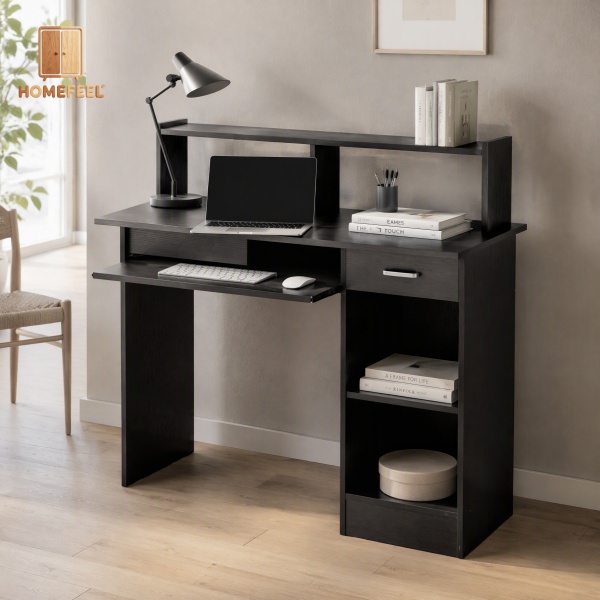
HF-CT003 measures 86.6 cm high, 100.1 cm wide and 40 cm deep at 16.7 kg, with a 70 cm wide, 61 cm high knee space that clears a narrow room. A 65 cm keyboard tray slides beneath the top, two exterior shelves take reference material, and the CPU sits on its own shelf rather than the floor. Rated capacity is 15.8 kg, so the desktop suits a laptop or a single monitor.
3.2 HF-CT001 High Load Capacity Computer Desk
HF-CT001 is the load-rated option: 110.2 lb on the tabletop, 22 lb on the compartment board and 11 lb on the keyboard tray, roughly 50 kg, 10 kg and 5 kg. The top is MDF over a solid wood base in a melamine finish, and the single drawer runs on full-extension metal roller glides with a safety stop. Boards are CARB P2-compliant, and the hutch shelf leaves an open channel for cables.
3.3 HF-CT005 Cable Management Computer Desk
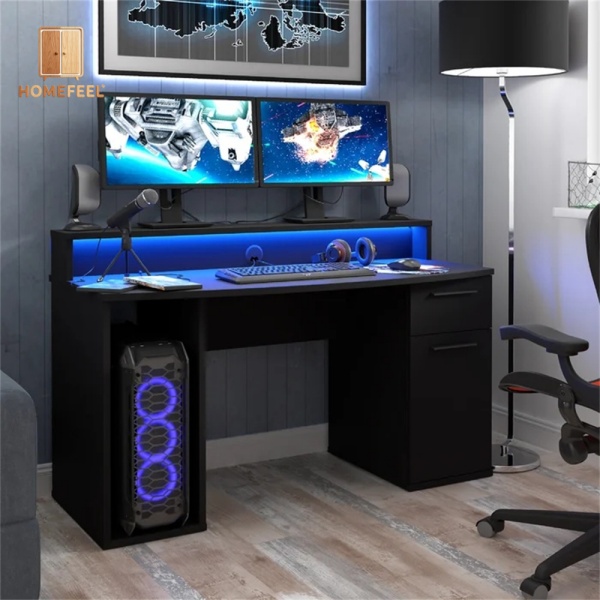
HF-CT005 measures 91.1 cm high, 140 cm wide and 65 cm deep at 51.5 kg, with a cable-managed pedestal, one cabinet, one drawer and a built-in USB port. Rated capacity is 60 kg. It suits a household that arrives with a dock, two screens and a printer, and keeps the working surface clear.
All three run through the flat-pack packing our factory has used for UK and European shipments for over a decade, tested to the SGS drop standard.
4 What This Means for B2B Buyers
Check knee space, load per surface and cable routing before style. A range built on those three numbers covers a student room, a dual-monitor study and a shared apartment without adding designs, and gives a sales team something concrete to quote.
Post time: Oct-23-2026